
For years, I have worked at the intersection of culture, creativity and social impact. I have designed festivals, developed artistic programmes, built partnerships and explored how hybrid cultural engagement can help people participate in culture despite physical, geographical or social barriers.
Technology was always present in this work, but it often remained on the other side of a wall.
I could imagine the experience, define what audiences and artists needed and explain how a platform should function. Yet translating that vision into code depended almost entirely on someone else, and that was deeply frustrating. Like many founders without a technical background, I had to communicate my ideas to developers and then wait to see whether the final product reflected what I had imagined. I often became frustrated because the result rarely matched the way my mind had conceived it through a creative lens. Sometimes, I would push back with the technical experts. Most of the time, however, I would let things go to avoid spending even more energy.
Recently, something changed.
I learned how to use AI-assisted “vibe coding” with Claude. For the first time, I could enter the technical structure of Basita, understand how different parts of the platform connect and begin making changes myself, changes that genuinely correspond to my creative practice. I was no longer standing outside the technology, describing what I wanted while trying to tone down my creative mind. I was participating directly in its creation.
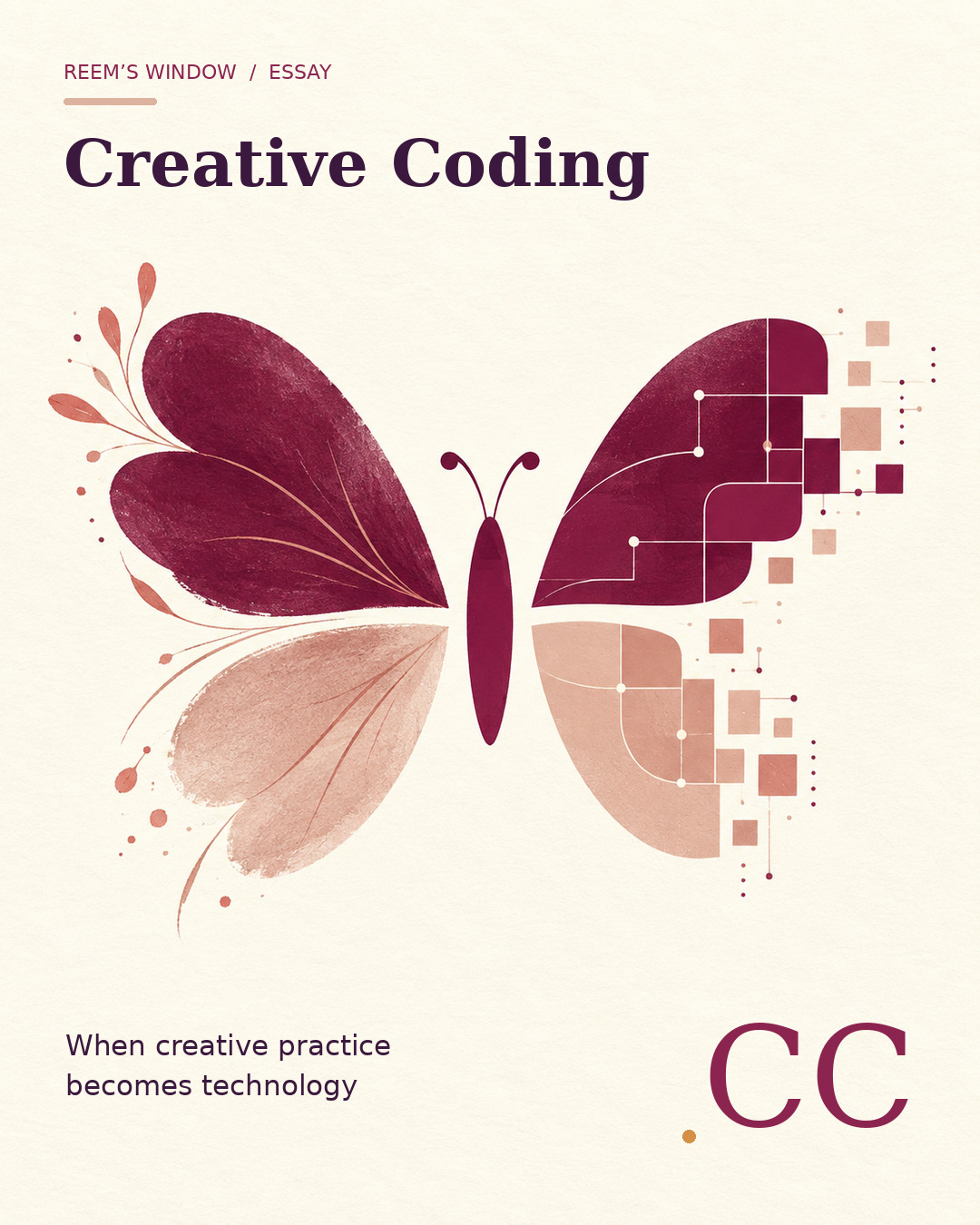
I feel as though I have wings now.
I am choosing to call this emerging practice Creative Coding, or CC.
The creative practice comes first
For me, Creative Coding does not simply mean using code to produce an artistic outcome. It means translating an existing creative practice, or even a creative need, into technology.
The process begins with questions that are cultural and human rather than technical:
- How should an audience discover an artist whose work they do not yet know how to search for?
- How can a platform understand that an online performance is not merely a video, but a cultural encounter, a form of cultural engagement?
- How can technology support hybrid participation without treating physical and digital experiences as separate worlds?
- How can artists gain access to data, visibility and income without losing control over their work?
These questions emerge from years of cultural practice. Coding becomes the tool through which they can be transformed into functions, interfaces and digital experiences.
The code is not the beginning. The creative practice is.
Reclaiming control of Basita
Basita was created in 2020 as a response to crisis. Cultural venues were closing, artists were losing access to audiences and the sector urgently needed new ways to gather, present work and remain connected. During this period, Basita was also integrated into my PhD research as a tool for engaging vulnerable communities and supporting them in building resilience.
Since then, Basita has grown into a platform for virtual, physical and hybrid cultural events. It has brought together thousands of users and hundreds of artists and content creators, while hosting hundreds of cultural events.
Yet building a technology platform while depending entirely on external technical knowledge creates vulnerability. Every adjustment, experiment or new idea requires translation and even mediation. Sometimes, the person writing the code understands the instruction but not the cultural intention behind it. At other times, the founder understands the experience that needs to be created but cannot see how the existing system is structured.
Creative Coding is beginning to close this gap for me.
I can now explore the platform more directly. I can identify where a problem occurs, describe the intended experience, work with an AI coding assistant to develop a solution and test whether it functions as expected. I am gradually gaining the ability to participate in decisions that were once hidden behind technical language. I am also able to ensure that those decisions are creatively and culturally informed.
This does not mean that I have suddenly become a traditional software engineer. It means that I am developing a new form of creative and technical agency.
Yes, agency!
Coding as translation
Creative Coding is fundamentally an act of translation.
It translates artistic values into platform rules.
It translates audience behaviour into design decisions.
It translates cultural-sector challenges into technical functions.
It translates an idea developed through practice into something people can see, use and experience.
This translation requires more than writing a prompt and accepting the first result. It involves questioning, testing, refining and sometimes beginning again. The AI may generate the code, but it does not independently understand why a particular feature matters, how artists might experience it, what cultural sensitivities must inform it, how audiences will receive it or what impact it may have on them.
That responsibility remains human. It remains mine.
My role is to carry knowledge of the cultural field into the development process. I bring an understanding of artists, audiences, access, participation, cultural rights and hybrid engagement. AI brings speed, technical guidance and the ability to convert instructions into possible solutions. Creative Coding happens through the conversation between these forms of knowledge.
A different relationship with technical experts
Creative Coding does not eliminate the need for professional developers. Complex architecture, cybersecurity, data protection, performance and large-scale deployment still require specialist expertise.
What changes is the relationship.
A culturally informed founder who understands the basic logic of the platform can communicate more precisely with developers, assess proposed solutions and make informed decisions. Technical experts no longer receive only an abstract creative brief. They can work with a founder who understands both the intended cultural experience and the structure through which it may be delivered.
This creates a more balanced collaboration between creative and technical knowledge.
A new skill for cultural professionals
For a long time, cultural professionals were expected to learn the languages of cultural programming, fundraising, marketing, evaluation and management. Technology was often treated as rocket science, or as a separate specialism that entered the process only after the creative vision had already been formed.
AI-assisted coding is beginning to change this order.
Cultural practitioners can now enter the process of technological creation much earlier. They can prototype an idea, test an audience journey, build a small digital tool or demonstrate how a creative methodology could operate online. They do not need to abandon their identities as artists, researchers or cultural managers to do this.
They can code from within their practice. They can code from within their humanity.
For me, this is the potential of CC. It is not coding for the sake of coding. It is the ability to carry creative knowledge into technology without losing its meaning along the way.
Learning to code in this way has given me more than a new technical skill. It has given me a new relationship with something I conceptualised and helped create. Basita no longer feels like a platform whose technical core I can approach only through others. I can now enter it, question it and participate in shaping what it becomes next. I can finally take the controls and help it fly.
Creative Coding may still be an emerging part of my practice, but it has already changed my understanding of what a cultural founder can do.
I am not leaving cultural practice to enter technology. I am bringing cultural practice into the code.